
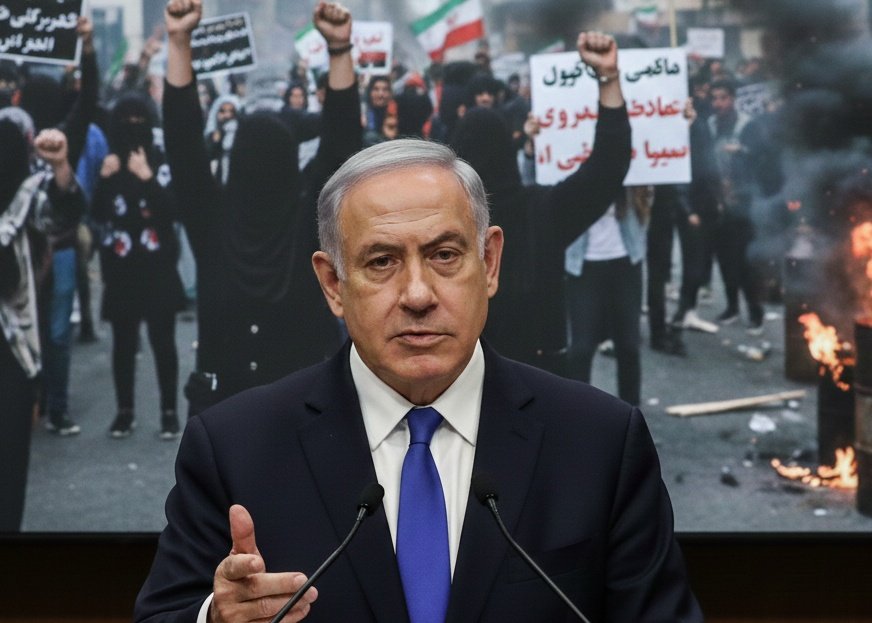

Israeli Prime Minister Benjamin Netanyahu’s public endorsement of demonstrations in Iran underscores longstanding tensions between the two nations, arriving as economic hardship drives calls for change in a country facing severe inflation and currency collapse.
On January 4, 2026, during his weekly cabinet meeting, Israeli Prime Minister Benjamin Netanyahu declared that “Israel stands in solidarity with the struggle of the Iranian people and with their aspirations for freedom, liberty and justice,” adding, “It is very possible that we are standing at a moment when the Iranian people are taking their destiny into their own hands”—a claim Israeli officials have framed as a potential turning point. The statement comes amid protests that began in late December 2025 over soaring inflation and currency devaluation, which have reportedly expanded into anti-regime chants in multiple cities, alongside a government response that monitoring groups say has resulted in at least 17 deaths. Netanyahu’s remarks, issued the same day as reports of clashes in western Iranian cities like Malekshahi, reflect Israel’s interest in pressuring Tehran’s leadership but stop short of outlining specific measures beyond verbal support.
References Used
Primary Sources:
- Transcript excerpts of Netanyahu’s cabinet remarks, as released via the Israeli Prime Minister’s Office and reported in real-time by outlets including i24NEWS and the Jerusalem Post.
- Official statements from Iranian state media (IRNA, Fars News, Tasnim News) and the Supreme Leader’s office (khamenei.ir) on protest timelines, casualty figures, and responses to foreign commentary; cross-referenced with human rights monitoring groups like Hengaw Organization for Human Rights.
- Iranian Foreign Ministry spokespersons’ briefings on external interference, as disseminated via official channels.
Secondary Reporting & Analysis:
- Coverage from Al Jazeera, The New York Times, The Guardian, BBC, and Iran International on protest origins, scale, and government responses.
- Wikipedia compilation of open-source data on the 2025–2026 Iranian protests, drawing from verified news and activist reports.
- Analysis from the Institute for the Study of War (Critical Threats Project) on regional implications.
Method Notes:
Reporting draws on publicly available dispatches from January 4, 2026, constrained by Iranian internet restrictions (down 35 percent during peak protest hours per NetBlocks) and limited access to western provinces. Figures on casualties, arrests, and protest scale vary between state media and independent monitors like Hengaw and Amnesty International; these remain unverified amid blackouts and no on-site access. Iranian state sources reflect official positioning and cannot be independently corroborated.
Context and Factual Grounding
The current wave of Iranian protests has its immediate origins in economic pressures that have intensified over the past year. By late December 2025, the Iranian rial had reportedly fallen to around 1.45 million per U.S. dollar, according to black-market trackers, while food inflation reached 72 percent and overall inflation 42.2 percent, per state statistics bureau data. These conditions arise from a combination of internal factors—persistent budget shortfalls, heavy subsidization of imports, and graft in state-affiliated firms—and external ones, such as U.S. sanctions reinstated through the UN’s “snapback” process in September 2025. Iran’s allocation of funds toward military aid for groups like Hezbollah and Hamas has strained domestic resources, worsening shortages in essentials like water and electricity.
Such strains build on a history of protest episodes linked to economic triggers. The 2017–2018 demonstrations against fuel price increases mobilized hundreds of thousands before a crackdown that Amnesty International estimates killed over 1,500; the 2019 gasoline subsidy unrest followed similar subsidy reductions without relief; and the 2022–2023 protests after Mahsa Amini’s death in custody grew into the widest anti-regime action since 1979, with monitoring groups reporting around 500 deaths and 22,000 arrests. These events reveal tensions in Iran’s bifurcated governance: a presidency elected in 2024 under Masoud Pezeshkian, who campaigned on reforms, constrained by Supreme Leader Ayatollah Ali Khamenei and the Islamic Revolutionary Guard Corps (IRGC), which holds sway over key economic and security domains.
The December 28, 2025, protests ignited in Tehran with coordinated bazaar strikes at sites like the Grand Bazaar and Alaeddin Shopping Centre, mirroring past patterns but set against a tense regional landscape. Earlier, in June 2025, the Twelve-Day War between Israel and Iran involved exchanges of airstrikes, drones, and missiles, with Israeli actions targeting alleged nuclear facilities and Iranian counterstrikes hitting civilian areas; U.S. forces later struck additional sites before a ceasefire. Accounts of the war’s scope differ sharply: Israeli officials claim severe degradation of Iran’s nuclear infrastructure, while Tehran asserts minimal impact and rapid recovery; independent assessments from the IAEA remain pending due to denied access since October 2025, leaving the status of roughly 400 kilograms of near-weapons-grade uranium unconfirmed and contested. The conflict’s aftermath, including reconstruction burdens and halted oil shipments, has deepened public disillusionment with Iran’s outward-focused policies.
As of January 4, 2026, monitoring organizations like Hengaw report unrest in at least 72 sites across 46 cities in 22 provinces, a reach that appears to exceed the 2022 Amini protests based on open-source videos and activist dispatches. Estimates of involvement suggest tens of thousands, encompassing bazaar traders, students at universities like Amirkabir and Beheshti, and factory workers in areas such as Isfahan. Early demands centered on economics—”Stabilize the exchange rate!”—before evolving into political slogans like “Death to the Dictator,” aimed at Khamenei, and references to Reza Pahlavi, the exiled son of the former shah. This progression highlights how livelihood issues often open doors to broader critiques of governance, though the lack of a central organizing body has repeatedly undermined cohesion in prior waves.
Claims, Signals, and Interpretations
Netanyahu’s reference to Iranians “taking their destiny into their own hands” positions the protests as a grassroots endeavor, consistent with Israel’s portrayal of the Islamic Republic as a regime alienated from its citizens. Shared at the cabinet’s start, the comments address varied listeners: Israelis grappling with Gaza fallout, Gulf partners wary of Iranian influence, and the U.S. administration under President Donald Trump, following Netanyahu’s recent talks on barring Iranian enrichment and extracting stockpiles. Their release coincides with Trump’s warnings of potential U.S. action against protester violence, hinting at aligned messaging to heighten Tehran’s strain. Analysts note that Netanyahu’s remarks also serve domestic and regional political purposes, projecting confidence at a moment when Iran continues to demonstrate institutional cohesion despite sustained pressure.
This portrayal of a claimed “moment,” however, warrants caution given precedents. Israel’s support for the 2009 Green Movement, where opposition figures challenged election results, met with repression rather than breakthrough. In the 2022 Amini case, statements from Israeli leaders like then-Prime Minister Naftali Bennett encouraged uprising but failed to shift internal dynamics. Netanyahu’s binary of aspiration against oppression simplifies a landscape of disparate groups—economic actors and ideological fringes—without addressing their uneven alliances.
Underlying motivations shape this narrative. Netanyahu’s coalition, strained by judicial disputes and internal rifts, gains from external positioning against Iran. The Twelve-Day War advanced Israel’s containment goals but left Iran’s program intact at 60 percent enrichment levels, per limited IAEA snapshots, heightening risks from proxies like Hezbollah. Linking endorsement to the unrest posits internal turmoil as a low-cost alternative to renewed strikes, a notion Netanyahu has raised with Trump, though its feasibility rests on unproven protester resilience.
The remarks also parallel a January 1 statement attributed to Mossad—”We are with you in the field”—phrasing some interpret as symbolic encouragement rather than operational commitment, with no public evidence of direct involvement. Such language seeks to erode cohesion in Iran’s security ranks, where many Basij and IRGC members share protesters’ economic hardships. Yet it confronts entrenched ties, including the IRGC’s control of up to 60 percent of the economy via illicit networks. Calls at January 2 funerals in Fuladshahr for security defections point to real tensions, but no widespread shifts have been documented.
Assumptions in Netanyahu’s appeal—that foreign voices unify rather than divide—clash with patterns where external endorsements often undermine protest legitimacy. Political science research, including studies on the “foreign taint effect,” shows regimes like Iran’s exploit such statements to paint dissent as imported sedition, rallying nationalists and justifying harsher measures, as seen in the 2009 crackdown following Western criticisms. This dynamic, while not deterring all participants, can isolate movements from moderate allies wary of geopolitical entanglement.
Speculation persists on covert extensions of Netanyahu’s rhetoric, such as cyber disruptions or dissident funding, but these remain unverified and outside confirmed reporting. The comments instead amplify exile figures like Reza Pahlavi’s strike appeals, circulating online despite connectivity curbs. Tehran counters by framing unrest as orchestrated abroad, a tactic deployed since 2009 to discredit participants.
Comparatively, the tone mirrors Trump’s December 31 alert of U.S. readiness for “rescue” if violence mounts—a escalation from his prior “maximum pressure” stance, per White House readouts. Netanyahu’s avoidance of pledges maintains flexibility, endorsing the cause without committing to results.
Viewed from Tehran, Netanyahu’s remarks are not read as solidarity but as strategic narrative pressure, deployed while Iran’s core power structures remain intact.
Iran’s Official Response and Narrative Contestation
Iranian state media and senior officials reject the premise that the protests represent a systemic rupture, framing them instead as economically induced disturbances amplified by external actors. According to a January 3 statement on khamenei.ir, Supreme Leader Khamenei described the unrest as “manageable challenges rooted in global pressures like sanctions,” emphasizing that “the Iranian nation stands united against Zionist psychological warfare.” Iranian Foreign Ministry spokesperson Esmail Baghaei echoed this on January 2 via IRNA, condemning Netanyahu’s remarks as “desperate attempts at interference” and asserting that “our security forces remain fully cohesive, with no signs of division.” These claims, disseminated through outlets like Fars News and Tasnim News, portray the demonstrations as contained riots rather than a broad revolt, with state messaging highlighting rapid stabilization efforts and public rallies in support of the government.
Such framing aligns with Tehran’s historical approach to unrest, where official narratives stress external orchestration to delegitimize dissent. A Tasnim News report on January 4 quoted IRGC spokespersons dismissing Israeli solidarity as “propaganda to incite chaos,” while underscoring the regime’s institutional durability amid past waves. These assertions cannot be independently verified and reflect official state messaging designed to project strength and rally domestic loyalty.
Power Structures and Constraints
Iran’s governance, with Khamenei’s overriding authority and the IRGC’s parallel command, curtails paths for internal adjustment. Pezeshkian’s January 1 call for “dialogue” through a proposed Communication Group has drawn doubt from observers, seen as echoing unkept 2022 pledges. The IRGC’s economic holdings, via conglomerates like Khatam al-Anbiya, foster resistance to fiscal changes that could ease inflation but threaten elite gains.
The Guardian Council’s candidate screening perpetuates hardline dominance, foreclosing electoral vents for grievances. Post-1979 constitutional provisions classify unrest as “moharebeh,” enabling lethal force; Khamenei’s January 3 order to subdue “rioters” (versus addressable “protesters”) has underpinned over 500 arrests in initial tallies from rights groups.
Sanctions post-Twelve-Day War isolate Iran financially, channeling trade to barters with Russia and China that sustain oil revenue but lag on civilian tech needs. Commitments abroad, including to Venezuela amid U.S. actions there on January 4, pull IRGC assets but reinforce anti-Western cohesion. Israel’s warnings of proxy reprisals underscore Tehran’s lingering reach, with Hezbollah’s arsenal intact despite missile losses.
Dissenters contend with fragmentation: urban traders seek concessions, youth challenge clerical rule, and diaspora input inspires without grounding logistics, amid Basij surveillance. Minorities in Kurdish and Baloch regions amplify voices but invite regime segmentation.
Outcomes hinge on capabilities over designs. The IRGC’s 190,000 personnel dwarf dispersed actions, aided by 35 percent connectivity drops. Disruptors like past cyber incidents affected sites but not the edifice; enduring change demands erosion from within.
Historical patterns further illustrate Iran’s capacity to absorb such episodes without foundational shifts. Monitoring groups and academic analyses, including from the Institute for the Study of War, document how prior protests—from 2017 to 2022—faded through a mix of concessions, repression, and narrative control, with no verified indicators of elite defections in the current cycle. Institutional mechanisms, such as the IRGC’s economic self-sufficiency and Khamenei’s veto power, have sustained cohesion even under compounded strains like the Twelve-Day War’s aftermath.
Consequences and Secondary Effects
Short-term fallout includes deepened economic disruption: bazaar closures in 21 provinces, per activist logs, have stalled daily trade in billions of rials, atop a 2025 GDP shrink of 4.5 percent from war effects. In hotspots like Mashhad and Shiraz, where monitoring groups report at least five deaths by January 3, individuals face tear gas risks and holds, with child casualties noted in Lordegan. State excuses of “weather-related” halts have further credibility gaps, while restricted feeds spread unconfirmed abuse footage, spurring external attention.
Iran’s divided focus dilutes proxies: Hezbollah-Israel clashes fell 20 percent in December, UN data indicate, as IRGC shifts inward. Gulf actors may bolster opposition media quietly, but Houthi actions in Yemen—tied to Tehran’s Venezuela stance—threaten 15 percent shipping cost rises.
Over time, prolonged action might unsettle nuclear efforts: site protests could prompt scientist exits, akin to 2022 disclosures. Subsidy yields might steady the rial briefly but inflate debts if oil slips under $70. Affected families, from Azna rally-mourners, carry lasting trauma; arrest tallies near 132, per Hengaw, burden overcrowded facilities with 250,000 political inmates.
Should momentum assumptions prove off—through partial reforms—burdens hit the exposed: traders ousted in reprisals, students facing mass dismissals. Ripples extend to Europe via potential 30 percent refugee upticks and U.S. debates on intervention limits.
Common Interpretations and Structural Insights
Interpretations often cast Netanyahu’s support as a spark for swift regime shift, yet patterns suggest external signals more commonly serve as echoes than drivers—the 2009 Green Movement waned despite U.S. acknowledgments, for instance. Israel’s role typically involves informational outreach over fieldwork; the Mossad phrasing draws readings as morale-building, not tactical, aligning with historical bounds on interference.
Iran’s economy blends sanction strains with internal opacity, where IRGC entities claim 40 percent of deals—a setup protests probe but rarely upend absent high-level breaks. Participant breadth—from stability-seeking merchants to secular advocates—resists uniform “uprising” tags; 2023 surveys indicate just 20 percent back monarchical revival, reflecting diverse aims.
On nuclear fronts, Netanyahu’s zero-enrichment call revives JCPOA-era impasses, but Iran’s reported 400kg holdings surpass thresholds, rendering extraction demands contingent on access long withheld—a loop of positions over progress.
What Is Known, What Is Uncertain
Confirmed Facts:
- Protests initiated December 28, 2025, in Tehran bazaars tied to rial weakness and over 40 percent inflation.
- Netanyahu delivered the remarks at his January 4, 2026, cabinet session, linked to Trump talks on enrichment curbs and stockpile extraction.
- Iranian officials enacted partial shutdowns in 21 provinces and arrested over 500, per state announcements.
- The June 2025 Twelve-Day War featured Israeli strikes on nuclear-linked sites, U.S. additions, and Iranian responses before truce.
Contested Claims:
- Monitoring groups like Hengaw report at least 17 deaths, including in Malekshahi and Lordegan; state media counters some as security losses by civilians.
- Mossad’s January 1 field-support claim, per leaks, is viewed by some as encouragement only, rejected by Tehran as fabrication.
- Trump’s December 31 U.S. “rescue” readiness, via briefings, lacks detail on execution.
- Iranian officials’ assertions of unified security forces and contained unrest, as stated via IRNA and khamenei.ir, reflect state framing without independent confirmation.
Unknowns or Missing Data:
- Precise turnout, hampered by dispersed sites and blackouts.
- IRGC internal responses to economic pulls on allegiance.
- Nuclear holdings’ post-war integrity, absent IAEA entry since October 2025.
Continued scrutiny is necessary to parse verifiable dynamics in Iran’s governance from hopes that risk extending hardship absent oversight.
Pingback: Record 296 Internet Shutdowns in 2024: Governments Use Blackouts to Curb Protests & Conflicts – Access Now Report