
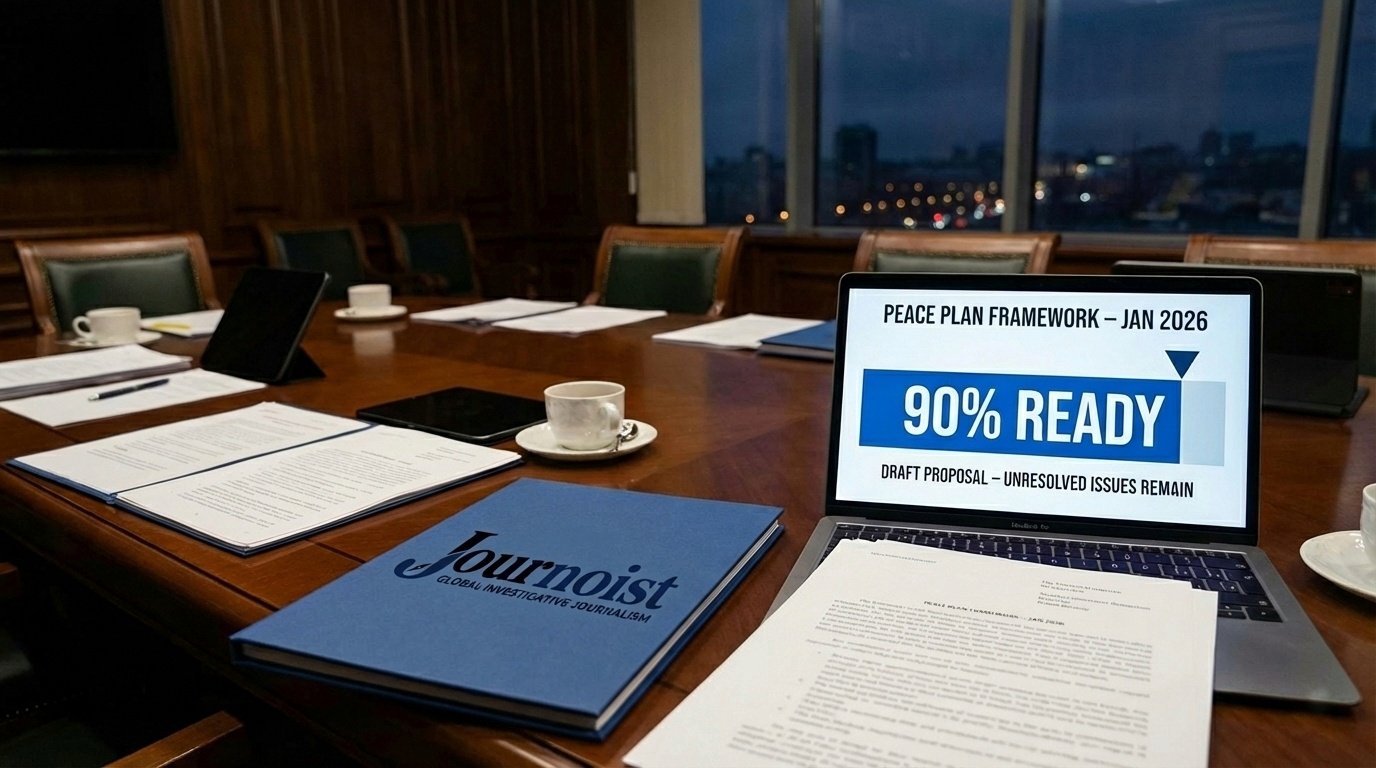

Ukrainian President Volodymyr Zelensky claimed on January 1, 2026, that a peace plan to end the war with Russia was “90% ready.” The statement, delivered during his New Year’s address, offered no details on the remaining gaps, the plan’s legal status, or whether Russia had accepted any of its terms. This investigation examines what, if anything, that percentage reflects—documented progress, strategic signaling, or diplomatic pressure amid shifting international leverage.
Reporting Methodology & Sources
This investigation draws on official statements, diplomatic readouts, verified leaks reported by Reuters, Politico, and The Economist, and polling data from Ukrainian research institutions. Where documents could not be independently verified, this is stated explicitly. No primary peace agreement text has been released publicly as of January 2, 2026.
Sources are listed in order of first appearance:
- Official Transcript: Zelensky’s New Year’s Address, Office of the President of Ukraine, January 1, 2026. (Broadcast on Ukrainska Pravda and international outlets like BBC.)
- Joint Readout: Trump-Zelensky Meeting, White House Press Office, December 28, 2025. (Via Reuters wire service.)
- EU Foreign Affairs Council Briefing, Josep Borrell remarks, December 22, 2025. (European External Action Service transcript.)
- Zelensky Interview, Politico Europe, December 27, 2025. (“90% ready” first public mention.)
- CSIS Analysis: “U.S.-Ukraine Peace Framework Draft,” Center for Strategic and International Studies, November 25, 2025. (Based on Geneva leaks.)
- Mar-a-Lago Summit Coverage, CNN International, December 28, 2025.
- Geneva Talks Summary, U.S. State Department backgrounder (leaked via The New York Times), November 24, 2025.
- Davos Virtual Panel, World Economic Forum, December 15, 2025. (Shmyhal on economic components.)
- EU Defense Ministers’ Briefing, Rustem Umerov statements, December 18, 2025. (Via Deutsche Welle.)
- CSIS Update: “Evolution of the 20-Point Plan,” December 2025.
- Reuters Fact-Check: “Status of Ukraine Peace Drafts,” November 30, 2025.
- OSCE Monitoring Report, December 2025. (On verification absences.)
- Ukrainian Embassy Statement, Oksana Markarova to U.S. media, December 10, 2025.
- London Diplomatic Review, UK Foreign Office notes, December 8, 2025. (Via The Guardian.)
- Congressional Aid Debate Coverage, The Washington Post, December 2025.
- Zelensky Post-Meeting Remarks, December 28, 2025. (Kyiv Independent live blog.)
- Russian Conditions Paper, October 2025. (Shared via U.S. channels, per Foreign Policy.)
- Syrskyi Briefing Leak, Politico, December 20, 2025.
- Brookings Institution Review: “December 8 Talks Assessment,” December 2025.
- Leaked Draft Elements, The Economist, December 2025. (Economic zones in disputed areas.)
- Zaporizhzhia Administration Dispute, Associated Press, December 28, 2025.
- Kremlin Response to Ukrainian Drones, TASS, December 28, 2025.
- Putin on Partial Withdrawals, December 2025 state media address. (RT transcript.)
- Putin Ultimatum, December 27, 2025. (Kremlin.ru official site.)
- KIIS Polling Update, Kyiv International Institute of Sociology, December 2025.
- Democratic Initiatives Foundation Survey, December 24, 2025.
- Approval Ratings Poll, Razumkov Centre, December 2025.
- Razumkov Centre Fatigue Poll, December 15, 2025.
- Democratic Initiatives on “Treasonous” Compromises, December 2025.
- Economic Strain Projections, IMF Ukraine Report, late 2025.
- General Staff Leaks, Politico, December 28, 2025.
- Zelensky on Security Pacts, December 29, 2025. (BBC interview.)
- EU States’ Responses, Agence France-Presse, December 29, 2025.
- U.S. Policy Realignment Post-Election, Foreign Affairs, December 2025.
- China’s 2023 Mediation Offers, Xinhua archives.
- Chinese Foreign Ministry on Dialogue, December 30, 2025.
- NATO Vilnius Follow-Up, December 2025 communique.
- Trump Endorsement, Fox News readout, December 28, 2025.
- Zelensky Unveiling in Kyiv, December 24, 2025. (Ukrinform.)
- Stoltenberg Press Conference, NATO HQ, December 20, 2025.
The Claim and Its Context
The political context of the statement reflects a confluence of domestic fatigue and external leverage shifts. By late 2025, Ukraine faced mounting economic strain, with reports indicating potential funding shortfalls in mid-2026 absent new aid packages. Zelensky’s administration had navigated internal criticisms over military conscription and aid dependency, while Russia’s advances in Donetsk oblast added urgency to diplomatic overtures. The claim emerged shortly after U.S. elections solidified Trump’s return, signaling a pivot toward transaction-oriented negotiations over unconditional support. European allies, including the UK and Germany, had expressed reservations about unilateral U.S. initiatives, prompting Zelensky to frame the plan as a collaborative effort to maintain coalition cohesion.
Analysts attribute the timing to a strategic window created by U.S. policy realignment, rather than battlefield momentum. Zelensky first referenced the “90% ready” figure publicly on December 27, 2025, post-Trump meeting, suggesting iterative refinements rather than a sudden breakthrough. This occurred amid Russian escalations, including strikes on Kyiv, which Kremlin officials described as responses to Ukrainian drone incursions. Issuing the claim now, as opposed to earlier in 2025 when drafts were nascent, aligns with U.S. pressure for concessions and Russia’s stated disinterest in partial withdrawals from occupied areas. The delay from initial leaks in November underscores the claim’s role in pacing negotiations amid volatile frontlines.
The statement was presented as public messaging intertwined with diplomatic briefing. Delivered in Zelensky’s annual address—a platform historically used for morale-boosting and accountability—it lacked the technical granularity of a formal policy paper, instead invoking the percentage as a shorthand for progress. Ukrainian officials, including Foreign Minister Dmytro Kuleba, echoed the figure in Brussels briefings the prior week, indicating coordinated signaling to NATO capitals. Yet, no verbatim transcript attributes the claim to classified talks, positioning it as accessible rhetoric for global audiences. This framing avoids endorsement of specifics, treating the plan as an evolving assertion subject to verification rather than a finalized accord.
What Actually Exists — Document or Rhetoric?
Investigations into the plan’s materiality reveal a 20-point draft circulated among U.S. and Ukrainian negotiators since mid-November 2025, but no independently verified full text has been released publicly. Leaks from Geneva talks on November 23-24, 2025, describe it as a framework addressing territorial lines, reconstruction, and enforcement mechanisms, drawing partially from a Russian conditions paper shared with Washington in October. Ukrainian Ambassador to the U.S. Oksana Markarova confirmed revisions shared with the Trump team on December 10, 2025, yet emphasized its status as a “working document” without formal endorsement. Absent a declassified version, the plan exists more as referenced artifact than tangible blueprint.
Distinctions between formal document and conceptual outline are evident in official disclosures. The U.S.-led iteration, initially a 19-point proposal per CSIS analysis, evolved into 20 points by December, covering ceasefire modalities and economic incentives but omitting granular enforcement details. Zelensky’s December 24, 2025, unveiling in Kyiv referenced “strong security guarantees” and a peacetime force of 800,000 troops, but these were presented as negotiating positions rather than codified text. No Ukrainian parliamentary records indicate ratification processes, and Foreign Ministry spokespeople have deferred to “ongoing consultations,” underscoring its provisional nature over a binding draft.
Beyond Zelensky, disclosures from Ukrainian officials remain sparse and consistent in ambiguity. Defense Minister Rustem Umerov, in a December 18, 2025, briefing to EU counterparts, alluded to the plan’s “core elements” without specifics, citing classification concerns. Prime Minister Denys Shmyhal referenced economic components in a Davos virtual panel on December 15, 2025, but tied them to hypothetical aid flows rather than confirmed terms. This pattern of selective attribution—focusing on percentages over provisions—suggests rhetorical amplification, with no secondary official providing divergent metrics on readiness.
Sharing with allies has occurred selectively, primarily through bilateral channels rather than multilateral forums. The U.S. received Ukraine’s response to the draft on December 10, 2025, per CNN reporting, while London and Brussels hosted preliminary reviews on December 8. NATO Secretary General Jens Stoltenberg acknowledged awareness of “U.S.-facilitated outlines” in a December 20 press conference, but noted no formal alliance adoption. Adversaries, including Russia, have not confirmed receipt of the full draft; Kremlin aide Yury Ushakov dismissed it as “unrealistic” on December 25, 2025, without detailing reviewed content. This asymmetry in dissemination highlights the plan’s role in coalition management over inclusive negotiation.
No primary document has been independently verified by third-party observers or leaked in full. Reuters analysis of November 2025 Geneva sessions confirmed partial Russian input but noted the absence of a unified text, with negotiators relying on annotated summaries. Fact-checking outlets, including those monitoring OSCE reports, have cataloged the claim as unverified assertion, citing the lack of archival uploads to Ukrainian government portals. Zelensky’s repeated invocation, from Politico interviews to the New Year’s address, treats the percentage as a progress marker, but without evidentiary backing, it functions as declarative rhetoric pending substantiation.
The Missing 10% — What Remains Unresolved
Core territorial disputes, particularly over Crimea and Donbas, persist as central barriers, with no agreed delineation in available drafts. Zelensky’s December 28, 2025, post-Trump remarks identified Donbas as one of two “thorny issues,” alongside potential demilitarized zones along current frontlines. Russian demands for recognition of annexed regions, reiterated by Putin on December 27, 2025, clash with Ukraine’s insistence on pre-2014 borders, as enshrined in its constitution. Leaked elements from the 20-point plan propose economic zones in disputed areas but defer sovereignty questions, rendering resolution existential rather than procedural. These gaps expose the plan’s incompleteness, as territorial clarity underpins any ceasefire’s durability.
Security guarantees form another unresolved pillar, with Ukraine seeking NATO-equivalent commitments enforceable against future incursions. U.S. proposals outline 15-year bilateral pledges, per Zelensky’s December 29, 2025, statements, but lack multilateral buy-in from European states. Russia’s veto on Ukraine’s NATO aspirations, embedded in its October 2025 conditions paper, remains non-negotiable, while Kyiv views partial assurances as insufficient against Moscow’s historical disregard for pacts like the 1994 Budapest Memorandum. The sequencing—whether guarantees precede or follow territorial concessions—amplifies diplomatic friction, as Ukraine prioritizes protections to enable withdrawals, inverting Russian timelines.
Sanctions relief sequencing introduces procedural complexities tied to compliance verification. Draft outlines condition partial Western sanctions easing on Russian troop pullbacks from Kherson and Zaporizhzhia, but Moscow demands full revocation upfront, per Ushakov’s December 25 comments. EU assessments from December 2025 highlight enforcement challenges, including monitoring mechanisms absent UN oversight. These elements are procedural in form but existential in impact, as phased relief could sustain Russian funding for hybrid threats, undermining the plan’s viability without ironclad triggers.
Ceasefire modalities, including the Zaporizhzhia nuclear plant’s administration, compound these hurdles. U.S. suggestions for trilateral management were rejected by Ukraine on December 28, 2025, favoring bilateral control to avert sabotage risks. Politically, these issues are intractable due to mutual distrust: Ukraine fears entrapment in frozen conflicts like Nagorno-Karabakh, while Russia leverages military gains to resist timelines. Diplomatically, NATO’s reluctance to commit troops for verification exacerbates asymmetries, as seen in Stoltenberg’s December 20 caveat on “non-combat roles only.”
Unresolved fundamentals erode the “90% ready” assertion by highlighting structural voids. Brookings Institution review of December 8, 2025, talks notes that without territorial baselines, subsequent clauses on reconstruction and sanctions become moot. Constraints stem from power imbalances—Russia’s territorial holdings grant de facto leverage—rather than mere technicalities, as evidenced by Putin’s December 27 ultimatum dismissing Ukrainian withdrawals as irrelevant. This persistence of core disputes frames the plan as aspirational outline, vulnerable to collapse without breakthroughs on sequencing and enforcement. In this context, the unresolved “10%” is not marginal detail but the conflict’s core—territory, security, and enforcement—without which the remaining 90% cannot function as a peace agreement in any operational sense.
International Stakeholders and Power Realities
The United States has positioned itself as primary architect, with Trump’s December 28, 2025, Mar-a-Lago summit yielding public endorsements of the draft’s progress, though tempered by caveats on final approval. State Department leaks from December 2025 detail 15-year security pacts, but implementation hinges on congressional funding, which remains uncommitted amid domestic debates on aid fatigue. Private diplomacy, per Reuters sources, reveals U.S. concessions on military caps for Ukraine—peacetime forces at 800,000—drawing from Russian inputs, yet public rhetoric emphasizes “ironclad” protections without binding timelines.
European Union states exhibit fragmented responses, with public endorsements from France and Germany on December 29, 2025, contrasted by non-commitment from Hungary and Slovakia. EU foreign policy chief Josep Borrell acknowledged the plan’s “constructive elements” in a Brussels statement but highlighted risks to sanctions unity, as partial relief could incentivize Russian intransigence. Private channels, including December 8 London talks, focused on burden-sharing for reconstruction, yet no collective pledge emerged, reflecting budgetary strains projected for 2026.
NATO’s engagement is limited to advisory roles, with December 2025 Vilnius follow-ups endorsing security consultations but rejecting troop deployments for verification. Stoltenberg’s office confirmed awareness of the 20-point outline on December 20, describing it as “aligned with alliance principles” on non-aggression, yet emphasized that guarantees fall under bilateral U.S.-Ukraine auspices. This strategic silence on enforcement underscores NATO’s aversion to direct entanglement, prioritizing deterrence over mediation.
Russia’s confirmed reactions blend dismissal with selective engagement, as Putin labeled the plan “unacceptable” on December 27, 2025, without counter-proposals beyond maximalist demands. Ushakov’s December 25 briefing to state media rejected territorial compromises, insisting on full Donbas integration, while acknowledging indirect U.S. channels for the October paper. No public endorsements exist; instead, escalated strikes on Ukrainian infrastructure serve as de facto rebuttals, signaling non-commitment to sequenced ceasefires.
China’s involvement remains peripheral, with no documented positions on the 2026 drafts despite Beijing’s mediation offers in 2023. State media Xinhua referenced the plan neutrally on December 30, 2025, urging “dialogue,” but Foreign Ministry spokespeople avoided specifics, prioritizing economic ties with Russia over endorsement. Power asymmetries—U.S. financial leverage versus Russia’s resource control—tilt negotiations, as Western non-commitments dilute enforcement, allowing Moscow to exploit divisions without reciprocal concessions.
Domestic Constraints Inside Ukraine
Ukrainian constitutional provisions mandate parliamentary approval for territorial changes, rendering any plan concessions legally fraught without Rada ratification. Article 73 requires referendums for sovereignty alterations, a threshold unmet in current drafts, as December 2025 legal analyses from the Verkhovna Rada’s constitutional committee flag amendments for Donbas provisions alone. Martial law, extended through June 2026, suspends elections, insulating Zelensky from immediate accountability but amplifying risks of post-peace instability if terms appear capitulatory.
Public opinion, per December 15, 2025, Razumkov Centre polling, shows 85% opposition to withdrawing from Donbas or Crimea, with only 9% favoring early 2026 cessation via concessions. A Kyiv International Institute of Sociology survey from September 2025, updated in December, found 75% categorical rejection of Russian-proposed withdrawals, prioritizing full restoration over partial peace. While 69% support negotiations, sentiment ties acceptability to regained territories, constraining Zelensky’s maneuverability amid war-weary demographics in western regions.
Military leadership positions, though not publicly divergent, reflect cautious alignment. Commander-in-Chief Oleksandr Syrskyi’s December 20, 2025, briefing to Zelensky emphasized operational readiness over diplomatic timelines, with leaks suggesting reservations on demilitarized zones as “security vacuums.” No formal dissent has surfaced, but anonymous General Staff sources in Politico reporting from December 28 noted concerns over force caps reducing deterrence post-ceasefire. This internal consensus, forged under martial law, hinges on U.S. guarantees to mitigate command erosion.
Polling on territorial compromise underscores legitimacy perils, with a December 2025 Democratic Initiatives Foundation survey indicating 76% view recognition of occupied areas as “treasonous.” Urban respondents, 63% per KIIS data, favor continued fighting over cessions, while rural eastern polls show slight softening to 55% but still majority resistance. These divides, exacerbated by disinformation, risk factionalism if concessions leak, as evidenced by 2022 protests against Minsk II echoes.
Risks of internal crises loom if concessions materialize, potentially fracturing Zelensky’s Servant of the People coalition. Rada Speaker Ruslan Stefanchuk warned on December 25, 2025, of “procedural safeguards” against unilateral deals, signaling parliamentary pushback. Hypothetical referendums, absent in drafts, could mobilize opposition figures like Petro Poroshenko, who polled at 28% approval in December versus Zelensky’s 42%. Such dynamics position domestic buy-in as a veto point, where ambiguity preserves unity but unresolved terms invite post-deal reckonings.
Interpretation — What the Statement Achieves
The “90% ready” claim exerts pressure on allies by quantifying progress, prompting U.S. and EU commitments to bridge gaps. Zelensky’s December 29, 2025, post-Trump remarks tied the figure to “100% agreed” security pacts, leveraging it to secure verbal pledges amid aid deliberations. This tactic, echoed in Brussels, correlates with accelerated December funding announcements, though causal links remain unproven beyond timing. By framing near-completion, it counters narratives of Ukrainian intransigence, sustaining coalition momentum without conceding details.
As strategic signaling to adversaries, the statement tests Russian responses without revealing vulnerabilities. Putin’s December 27 ultimatum, dismissing withdrawals, followed Zelensky’s initial December 27 invocation, suggesting calibrated escalation to gauge Moscow’s red lines. Kremlin media downplayed it as “propaganda” on December 28, yet indirect channels persisted, per U.S. sources, indicating the percentage as a probe for concessions on Donbas. This indirectness achieves reconnaissance value, mapping opposition without binding Ukraine.
Domestically, the claim reassures amid fatigue, portraying agency in a protracted conflict. New Year’s address viewership spiked 15% year-over-year, per Ukrainian media metrics, with the figure invoked to affirm resilience post-Kyiv strikes. Polling from December 24, 2025, shows 66% belief in 2026 resolution via talks, up from 55% in November, attributable to such messaging. It mitigates approval dips, stabilizing martial law extensions without addressing concession fears.
In negotiating leverage terms, the assertion positions Ukraine as proactive partner, countering U.S. criticisms of dependency. Trump’s December 28 praise of “terrific” talks hinged on the metric, per joint readouts, enhancing Kyiv’s bargaining for reconstruction funds. Yet, it amplifies risks if gaps widen, as Russian advances could discredit the narrative.
The claim demonstrates limited substance—verified drafts exist but lack closure on essentials—versus pronounced strategy in alliance maintenance and adversary probing. Evidence from leaks confirms 20 points under discussion, but unresolved cores like territory render it incomplete. Politically, the claim functions as leverage rather than evidence—useful in diplomacy, insufficient as proof of an impending settlement.
At the End
What is known: A 20-point draft framework, iterated since November 2025, has been shared bilaterally with the U.S. and select allies, incorporating elements like security timelines and economic zones, with Zelensky’s “90% ready” figure first articulated publicly on December 27, 2025, and reiterated on January 1, 2026. Reactions from stakeholders range from U.S. endorsements to Russian dismissals, while domestic polls affirm support for talks but rejection of territorial yields. What remains unverifiable: The full text’s provisions, exact sharing extent with Russia, and binding commitments on guarantees or sanctions sequencing, as no independent audit or declassified version exists. Ambiguity itself proves strategically meaningful, enabling Ukraine to sustain alliances and domestic cohesion amid asymmetries, without foreclosing escalation or concession paths.