
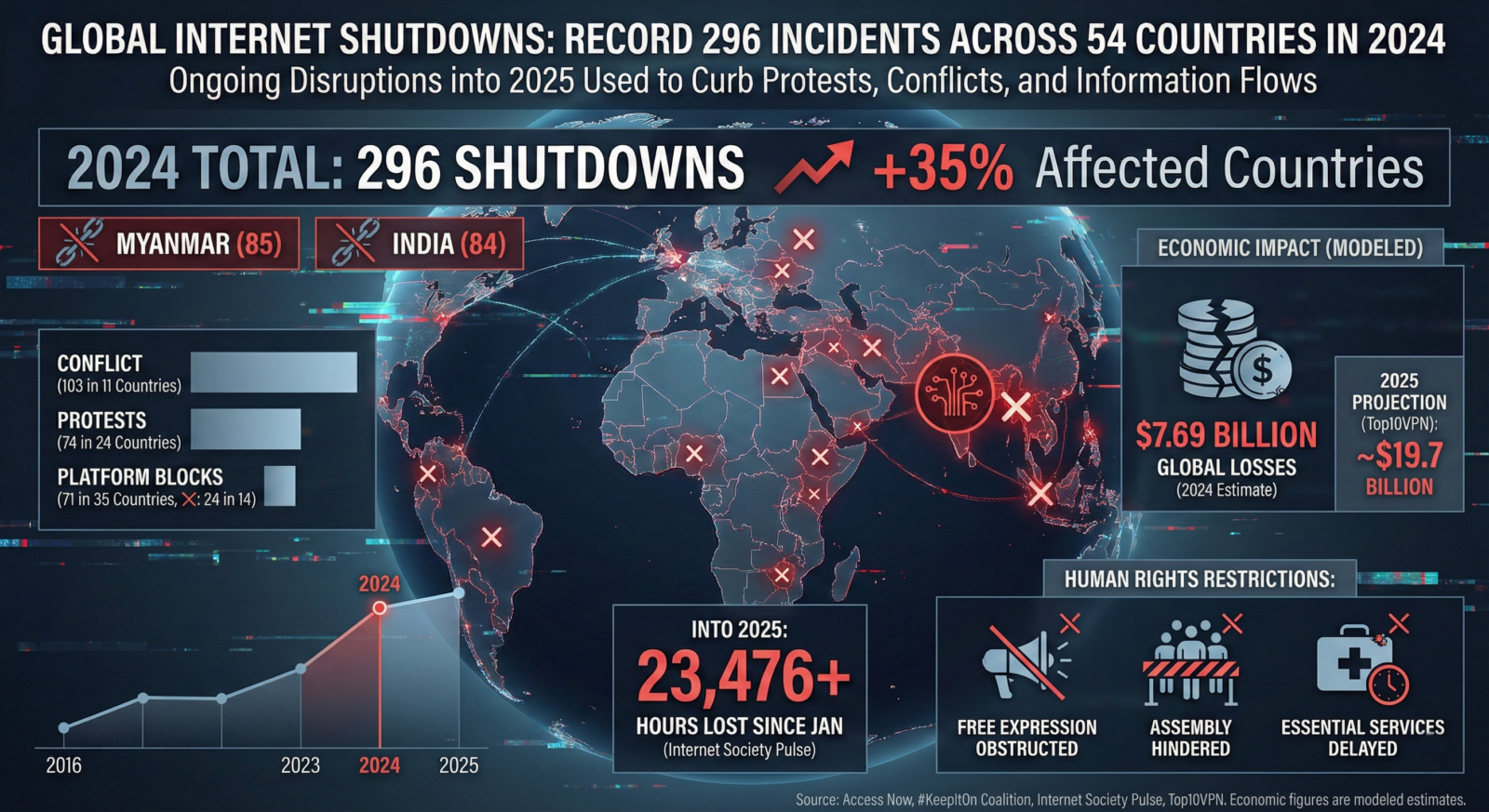

Access Now and the #KeepItOn coalition tracked 296 deliberate government-imposed internet shutdowns in 2024—the highest annual total since monitoring began in 2016—primarily during conflicts and protests, inflicting modeled economic damages estimated at $7.69 billion globally that year and contributing to documented restrictions on freedoms of expression, assembly, and access to essential services.
Access Now and the #KeepItOn coalition’s 2024 report documented at least 296 government-imposed internet shutdowns across 54 countries, surpassing the prior record and reflecting a 35% increase in affected countries from previous highs, with Myanmar (85 incidents) and India (84) accounting for the majority. These disruptions, ranging from nationwide blackouts to regional or platform-specific restrictions, were most commonly triggered by conflict (103 incidents in 11 countries) and protests (74 in 24 countries), while platform blocks—particularly on X (formerly Twitter)—reached new highs with 24 restrictions across 14 countries. Economic modeling from Top10VPN estimated global losses at $7.69 billion in 2024 from major deliberate disruptions, with human rights organizations documenting severe impacts including obstructed access to information, hindered protest coordination, and, in conflict settings, delayed humanitarian responses and emergency communications.
References Used
Primary Sources:
- Access Now and #KeepItOn coalition report: “Emboldened Offenders, Endangered Communities: Internet Shutdowns in 2024” (February 24, 2025), detailing 296 shutdowns in 54 countries, breakdowns by trigger (e.g., 103 conflict-related), country leaders (Myanmar 85, India 84), and platform blocks (71 in 35 countries, X in 24 cases).
- Internet Society Pulse shutdown tracker (ongoing through 2025), recording cumulative hours of intentional disruptions and specific incidents into late 2025.
Secondary Reporting & Analysis:
- Top10VPN “Cost of Internet Shutdowns” reports (2025 edition covering 2024 data: $7.69 billion global estimate from 167 major incidents in 28 countries lasting 70,451–88,788 hours; 2025 modeled surge to $19.7 billion amid over 120,000 hours).
- Coverage from TechRadar, Context (Thomson Reuters Foundation), Axios, Business Standard, and others summarizing Access Now findings, conflict/protest triggers, and economic/human implications.
Method Notes: Verification relies on public reports from Access Now/#KeepItOn (coalition of 345+ organizations) and Internet Society Pulse trackers. Economic figures are modeled estimates using tools like NetBlocks COST, based on GDP/digital economy indicators, duration, and affected population—not audited totals. Counts may vary slightly by methodology (e.g., full blackouts vs. platform blocks); no proprietary or non-public data used. Human rights impacts draw from documented correlations in reports, with specific examples noted where available.
Context and Factual Grounding
Internet shutdowns gained prominence as a documented government tactic during the 2011 Egyptian protests, when connectivity was severed to disrupt coordination. Since systematic tracking began in 2016, incidents have risen steadily, evolving to include partial throttles, platform blocks, and targeted satellite disruptions.
The Access Now/#KeepItOn 2024 report confirmed 296 shutdowns in 54 countries—the peak year—up from 283 in 39 countries in 2023. Myanmar’s military junta led with 85 incidents (76 military-orchestrated), often to obscure abuses amid conflict. India followed with 84, frequently regional during communal tensions, protests, or exams. Pakistan and Russia ranked among top offenders, with combined shares from key Asian states exceeding 60–70% in some analyses.
Conflict drove 103 shutdowns across 11 countries (e.g., Myanmar, Sudan, Ethiopia, Gaza-related), while protests triggered 74 in 24. Elections, exams, and other pretexts contributed. Platform-specific blocks surged to 71 in 35 countries, with X most affected (24 blocks in 14 countries) and TikTok seeing increases.
Into 2025, Internet Society Pulse tracked ongoing disruptions (e.g., cumulative 23,476+ hours lost globally since January 2025 across 14+ countries), including election-related blackouts and conflict blocks. These reflect governments’ technical control over telecom infrastructure, often justified as preserving order but widely deemed disproportionate under international human rights law.
Claims, Signals, and Interpretations
Authorities ordering shutdowns—typically executives, military, or regulators—justify them as necessary for security, countering disinformation, exam integrity, or public order (e.g., Myanmar junta framing as control during operations; India citing communal harmony). Timing correlates with high-risk events: protests (e.g., Kenya 2025 commemorations), conflicts (obscuring military actions), or elections.
Incentives include narrative control and preventing mobilization; Access Now linked many Myanmar cases to concealing violations. Critics argue shutdowns create information vacuums that spread misinformation and enable abuses. Platform blocks target specific dissent channels while allowing partial access.
Assumptions of short-term utility (e.g., reduced unrest) contrast with evidence of long-term harm; reports show shutdowns exacerbate instability without proven effectiveness against determined activism.
Power Structures and Constraints
State control over telecoms enables shutdowns: centralized networks allow orders to ISPs via licensing or direct authority. Material capacity includes tools for throttling or full cuts, with newer tactics targeting satellite services (e.g., Myanmar 2024 cases).
Enforcers face normative constraints from international standards (UN resolutions, African Commission rulings) and civil society pressure (#KeepItOn coalition advocacy). Telecom compliance often stems from license risks. Publics vary: affected groups suffer most (e.g., protesters, conflict civilians needing info), while some accept order-based rationales.
Global coalitions exert advocacy but lack direct enforcement; repeat offenders normalize the tactic despite condemnation.
Consequences and Secondary Effects
Short-term: disrupted emergency communications, business halts, protest suppression, and in conflicts, obscured abuses and delayed aid (e.g., humanitarian access barriers noted in Myanmar/Sudan reports). Economic modeling shows billions in losses from halted e-commerce, remittances, and productivity.
Long-term: eroded digital trust, deterred investment, widened divides (disproportionate harm to poor/vulnerable), and normalized censorship weakening expression/assembly rights. Populations in high-incident countries face repeated livelihood/education/healthcare disruptions; global norms on connectivity face erosion if unchallenged.
What Is Known, What Is Uncertain
Confirmed Facts:
- Access Now/#KeepItOn documented 296 government-imposed shutdowns in 54 countries in 2024, with Myanmar (85) and India (84) leading.
- Conflict triggered 103 incidents; protests 74; platform blocks reached 71 in 35 countries (X in 24 cases).
- Top10VPN modeled $7.69 billion global economic cost in 2024 from major disruptions.
- Internet Society Pulse tracks ongoing 2025 incidents and cumulative lost hours (23,476+ since January 2025).
Contested Claims:
- Exact causation and scale of prevented outcomes (e.g., unrest reduction) versus enabled abuses.
- Precise economic totals beyond modeled estimates (e.g., 2025 $19.7 billion projection from Top10VPN labeled as such).
Unknowns or Missing Data:
- Complete 2025 annual shutdown totals and final impact assessments.
- Under-reported covert or partial disruptions in certain regions.
- Long-term shifts in government behavior amid advocacy and condemnation.
Continued cross-verification of tracker data, rights reports, and economic models is necessary to evaluate whether internet shutdowns remain an entrenched political tool or encounter meaningful restraint through international pressure.


Pingback: Explaining the Surge: India Hate Lab’s 2025 Report Tracks 1,318 Documented Hate Speech Events Targeting Muslims and Christians - Journoist