
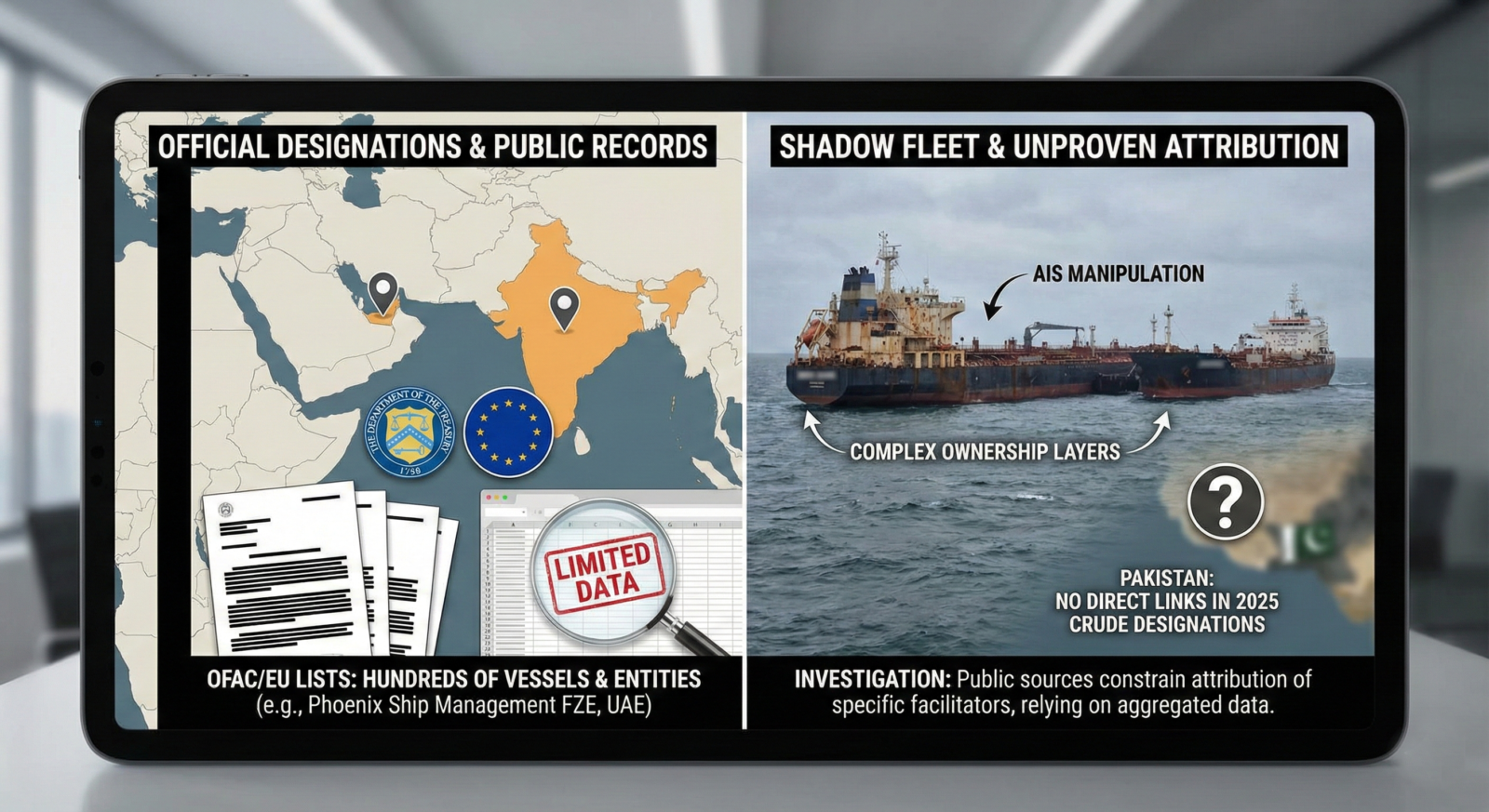

While US and EU sanctions authorities designated hundreds of vessels and entities in 2025 to disrupt shadow fleet operations linked to Russian and Iranian oil exports, publicly available records and reporting do not provide original investigative evidence of named facilitation networks in jurisdictions such as Pakistan, leaving broader regional claims dependent on existing aggregated data rather than new disclosures.
Throughout 2025 the US Department of the Treasury’s Office of Foreign Assets Control (OFAC) and the European Union continued to designate vessels, ship-management companies, and intermediaries asserted to support Russia’s oil exports and Iran’s petroleum trade in violation of sanctions regimes tied to Russia’s actions in Ukraine and Iran’s regional military activities. These actions targeted shadow fleet tactics—including AIS manipulation, ship-to-ship transfers, re-flagging, and complex corporate ownership—with frequent references to maritime and corporate activity in the UAE, India, and other locations. The material under review, however, contains no independent vessel-tracking analysis, leaked documents, financial forensics, or newly uncovered links; it therefore confines findings to what official designations and secondary reporting confirm while explicitly identifying where attribution remains unproven or absent, particularly with respect to Pakistan.
References Used
Primary Sources:
- US Department of the Treasury (OFAC) Specially Designated Nationals (SDN) List updates and press releases (2025), including January 9 designations of 183 vessels and entities linked to Russian oil and December 17–18 actions targeting 29 vessels and managers in the Iranian shadow fleet (e.g., Phoenix Ship Management FZE, UAE).
- European Council Implementing Regulations and Decisions (December 2025), including December 18 designation of 41 Russian shadow fleet vessels and December 15 addition of nine related enablers, several UAE-based.
Secondary Reporting & Analysis:
- Reporting from Reuters, Lloyd’s List, The Guardian, Kpler, and United Against Nuclear Iran (UANI) on shadow fleet tactics, re-flagging patterns (notably acceleration to Russian registry in late 2025), and third-country roles.
- No proprietary data sets, original AIS-derived vessel trails, or non-public regulatory filings included in the reviewed material.
Method Notes:
Analysis draws exclusively from public official designations, government press materials, and open-source journalism. No real-time proprietary tracking, field verification, or access to non-public intelligence was available. Persistent gaps in AIS data, deliberate vessel-name/flag changes, and corporate-layer opacity prevent exhaustive mapping. Pakistan-related assertions are limited to pre-2025 refined-product smuggling references and are not connected to 2025 crude-oil shadow fleet designations.
Context and Factual Grounding
Sanctions on Russia’s energy revenues expanded after February 2022 via G7 price-cap mechanisms and service prohibitions, while restrictions on Iran’s petroleum sector—reimposed in 2018 and enforced with increased intensity in 2025 under existing authorities—aim to limit funding for designated activities. Both countries rely on large shadow fleets of aging tankers employing high-risk practices to sustain exports, predominantly to Asian purchasers.
OFAC’s 2025 designations cumulatively targeted hundreds of vessels and related entities across both regimes; notable actions included January’s listing of 183 Russian-linked tankers and December’s targeting of 29 Iranian shadow fleet assets, several managed from the UAE (e.g., Nebula Drift, IMO 9233973, under Phoenix Ship Management FZE). The EU designated 41 additional Russian shadow fleet vessels on December 18, 2025, and related enablers on December 15, contributing to combined tallies approaching several hundred restricted vessels when aggregating all 2022–2025 measures.
India has consistently ranked as the largest buyer of Russian seaborne crude since 2022, according to trade-flow data and international reporting. The UAE hosts numerous ship-management firms, free-zone registrations, and corporate service providers used in shadow operations. Turkey appears in refining and transit capacities. These roles arise from economic incentives (discounted crude, service fees) and differing degrees of sanctions alignment.
Reported late-2025 acceleration of re-flagging to the Russian registry (noted in Lloyd’s List analyses) reflects adaptation to enforcement pressure. Environmental and navigational incidents involving substandard shadow vessels occurred during 2025, as covered in maritime-safety reporting.
Claims, Signals, and Interpretations
The reviewed material asserts quiet bypassing via South Asia and Middle East channels but ultimately finds that public sources do not permit attribution of specific, named facilitators beyond those already listed in OFAC and EU designations (e.g., UAE-based Phoenix Ship Management FZE, Kurdos Shipping Inc.). No new corporate trails, ownership mappings, or financial records are presented.
Incentives for third-country actors remain economic (chartering profits, discounted purchases); designations often follow intelligence or prior reporting clusters. Russia and Iran characterize sanctions as illegitimate; Western authorities frame targeted networks as deliberate circumvention. Informal value-transfer claims (hawala-like) appear in analytical literature but lack cited transaction-level evidence in the material.
Pakistan receives no linkage in 2025 OFAC or EU crude-oil shadow fleet designations; earlier reporting on cross-border refined-fuel smuggling is unrelated to the current maritime evasion patterns under review. The absence of attributable evidence for certain jurisdictions constitutes the central investigative boundary.
Power Structures and Constraints
Structural enablers of evasion include global maritime features: open ship registries, multi-layered anonymous ownership, and limited flag-state enforcement capacity. Material realities—aging hulls, higher insurance costs, incident exposure—constrain but do not halt operations at scale.
Enforcement authority rests primarily with OFAC’s secondary-sanctions reach and EU port-access and service prohibitions. Jurisdictions outside the G7 (India, China, others) retain trade-policy autonomy, limiting coercive leverage. The UAE selectively cooperates on individual designations while maintaining commercial openness; India prioritizes energy affordability.
International maritime law restricts unilateral interdictions; resource intensity of continuous global vessel tracking imposes practical limits on comprehensive disruption.
Consequences and Secondary Effects
Short-term outcomes include continued export revenue for Russia and Iran, documented environmental and safety risks from shadow operations, and periodic network disruption from rolling designations. Adaptation (re-flagging, new intermediaries) follows each enforcement wave.
Long-term, sustained evasion may erode perceived credibility of multilateral sanctions; conversely, cumulative cost increases (discounts, insurance, legal exposure) could pressure sanctioned economies if enforcement tightens further. Primary risk-bearers remain populations in origin states facing economic strain and crews aboard substandard vessels, alongside broader maritime commons exposed to pollution or accidents.
What Is Known, What Is Uncertain
Confirmed Facts:
- OFAC designated 183 vessels/entities linked to Russian oil in January 2025 and 29 Iranian shadow fleet assets (including UAE managers) in December 2025.
- EU designated 41 Russian shadow fleet vessels on December 18, 2025, and related enablers on December 15, several UAE-based.
- India remains the largest purchaser of Russian seaborne crude since 2022, per trade data.
- Shadow fleet tactics (AIS manipulation, STS transfers, re-flagging) are referenced in official designations and maritime reporting.
- Acceleration of re-flagging to Russian registry occurred in late 2025, per Lloyd’s List analysis.
- No 2025 OFAC or EU designations link crude oil shadow fleet activity to Pakistan.
Contested Claims:
- Extent and mechanics of informal financial channels supporting evasion (no transaction records cited).
- Precise degree of private versus state-aligned facilitation in UAE or India.
Unknowns or Missing Data:
- Original primary evidence (new vessel ownership trails, financial forensics, leaked filings) beyond public designations and reporting.
- Comprehensive current evasion volumes and exact revenue attribution.
- Future alignment or resistance of key buyer jurisdictions to intensified secondary pressures.
Continued monitoring of official designation lists, trade statistics, and independent maritime analysis is necessary to track whether enforcement closes identified gaps or if evidentiary boundaries persist.