
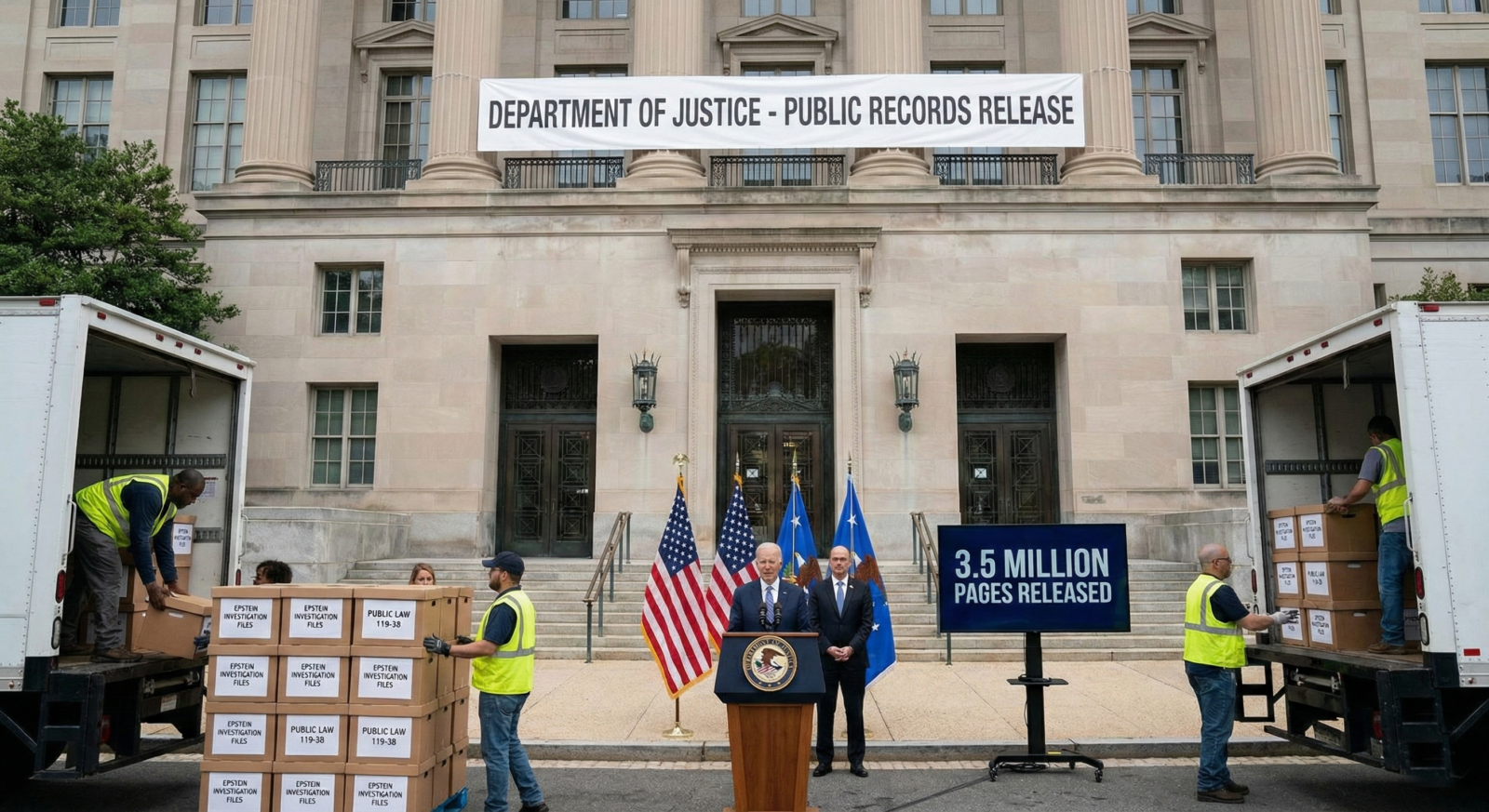

The Department of Justice has published a large volume of investigative materials tied to Jeffrey Epstein in response to the Epstein Files Transparency Act, though the release arrived after the statutory deadline and has drawn criticism over the scope of materials not made public.
On January 30, 2026, the U.S. Department of Justice announced the publication of over 3 million additional pages of records—combined with earlier tranches to reach nearly 3.5 million pages—responsive to the Epstein Files Transparency Act (Public Law 119-38), signed by President Donald Trump on November 19, 2025. The Act directed the Attorney General to make publicly available, in searchable format, all qualifying unclassified records related to federal investigations, prosecutions, or custodial matters involving Jeffrey Epstein and Ghislaine Maxwell, subject to defined exceptions. Deputy Attorney General Todd Blanche described the production as fulfilling the department’s obligations under the statute, while congressional critics, including Rep. Ro Khanna, have questioned whether the release covers the full set of responsive materials originally identified by the department.
References Used
Primary Sources:
- Department of Justice Press Release: “Department of Justice Publishes 3.5 Million Responsive Pages in Compliance with the Epstein Files Transparency Act” (January 30, 2026).
- H.R. 4405 (119th Congress), Epstein Files Transparency Act, Public Law 119-38 (signed November 19, 2025), text available via Congress.gov.
- DOJ Epstein Files production site (justice.gov/epstein).
Secondary Reporting & Analysis:
- Reporting from ABC News, BBC, CNN, NBC News, The New York Times, POLITICO, and The Guardian (January 30–February 1, 2026), confirming release volume, timing, and congressional statements on compliance.
- Legislative record and sponsor statements via Congress.gov.
Method Notes:
Analysis draws from the official DOJ announcement, the statute text, and contemporaneous reporting. No independent review of the full archive is conducted here; numerical estimates of potentially responsive but unreleased pages are attributed directly to sources that have cited them.
Context and Factual Grounding
Jeffrey Epstein was convicted in Florida in 2008 for procuring a minor for prostitution and faced federal sex-trafficking charges following his 2019 arrest in New York. He died in federal custody on August 10, 2019 (official ruling: suicide), which triggered investigations by the FBI, U.S. Attorneys’ Offices, and the DOJ Office of Inspector General.
Ghislaine Maxwell was convicted in 2021 on related federal charges and is serving a 20-year sentence. Public demand for additional government-held records persisted, driven in part by civil-case unsealing (e.g., Giuffre v. Maxwell) that identified associates but offered limited new evidence of third-party criminal involvement.
The Epstein Files Transparency Act was introduced by Rep. Ro Khanna (D-CA) in July 2025, passed the House 427–1 on November 18, 2025, cleared the Senate by unanimous consent the following day, and was signed November 19, 2025. It required release of qualifying unclassified records within 30 days (by December 19, 2025).
The DOJ conducted an initial identification of potentially responsive materials across multiple investigations. A major tranche—over 3 million pages, plus more than 2,000 videos and 180,000 images—was released January 30, 2026, exceeding the statutory deadline. The department stated it collected from five primary investigative streams and applied redactions or withholdings under statutory exceptions, privileges, and victim-protection requirements.
Claims, Signals, and Interpretations
The DOJ press release presents the release as compliant, emphasizing the scale of effort (over 500 attorneys/reviewers) and an additional SDNY protocol to safeguard victim-identifying information per court order. It stresses that redactions were limited to victim and family protection, privileges (deliberative-process, attorney-client), depictions of violence, and unrelated case materials. Prominent individuals and politicians were not redacted on those grounds.
The release includes public-submitted tips, which the department notes “may include fake or falsely submitted images, documents or videos.” It specifically addresses pre-2020 submissions containing “untrue and sensationalist claims against President Trump,” calling them “unfounded and false” and suggesting they would have been weaponized if credible.
Deputy Attorney General Blanche stated the department “didn’t protect or not protect anybody,” including the president. Congressional critics, including Rep. Khanna and Senate Democrats, have pointed to the department’s own earlier identification of roughly 6 million potentially responsive pages as evidence that a substantial portion—estimated by some at around 2.5 million pages—remains withheld, though the DOJ has not publicly confirmed that exact figure or provided a detailed breakdown of withholdings.
Media accounts report no major previously unknown revelations about third-party criminal conduct, with name mentions (including Trump and Clinton) largely consistent with prior public disclosures.
Power Structures and Constraints
The Act imposes a statutory obligation on the executive branch to disclose investigative files, narrowing traditional discretion while retaining exceptions for victim privacy, legal privileges, and certain sensitive content. Compliance rests on DOJ self-certification, with congressional oversight as the primary check.
Reviewing millions of pages, videos, and images required significant resources and time, extending beyond the 30-day mandate. Victim-protection duties (court-ordered in SDNY) and standard privilege doctrines necessitated redactions, constraining full release.
Public opinion is divided: survivors’ advocates have raised concerns about potential re-traumatization from graphic material, while transparency advocates argue that any gap between identified and released materials undermines the law’s purpose. Political cross-pressures exist—bipartisan passage reflected broad demand for disclosure, yet implementation under the current administration has prompted partisan critiques of delay and incompleteness.
Consequences and Secondary Effects
Short-term effects include a large public archive available for journalistic and independent review, which may clarify aspects of federal investigative handling without producing sweeping new findings on third parties.
Long-term, the perception of incomplete compliance—particularly if congressional critics’ estimates of withheld pages hold under scrutiny—could reinforce skepticism toward DOJ transparency in elite-related cases. Successful challenges to withholdings might encourage future mandatory-release laws.
Victims face risks of renewed exposure to traumatic content. The public bears the risk of misinformation if unvetted tips gain traction without context. Political figures named in records (even in unsubstantiated form) face reputational effects, though the release has not yet produced evidence altering prior understandings of criminal liability.
What Is Known, What Is Uncertain
Confirmed Facts:
- The Epstein Files Transparency Act was signed November 19, 2025, mandating release within 30 days.
- DOJ released nearly 3.5 million pages total, including a January 30, 2026 tranche of over 3 million pages, 2,000+ videos, and 180,000+ images.
- Materials stem from multiple Epstein/Maxwell-related investigations; redactions/withholdings protect victims, privileges, violence depictions, and unrelated items.
- Public tips were included without credibility screening and may contain false information.
- Trump’s name appears thousands of times, mostly in media references or allegations DOJ describes as unfounded.
Contested Claims:
- Congressional critics, including Rep. Khanna, have cited an earlier DOJ identification of roughly 6 million potentially responsive pages and suggested a significant portion remains unreleased; the department has not publicly confirmed or refuted that specific estimate.
- DOJ characterizes certain pre-2020 allegations against Trump as “unfounded and false”; those specific claims lack independent adjudication in the cited sources.
Unknowns or Missing Data:
- Precise volume and content of withheld materials, and the detailed application of each exception or privilege.
- Whether further analysis of the released archive will materially change public understanding of the Epstein network or federal decisions beyond existing disclosures.
Continued scrutiny of the public archive and congressional follow-up remain necessary to evaluate the completeness and implications of the mandated disclosure.