
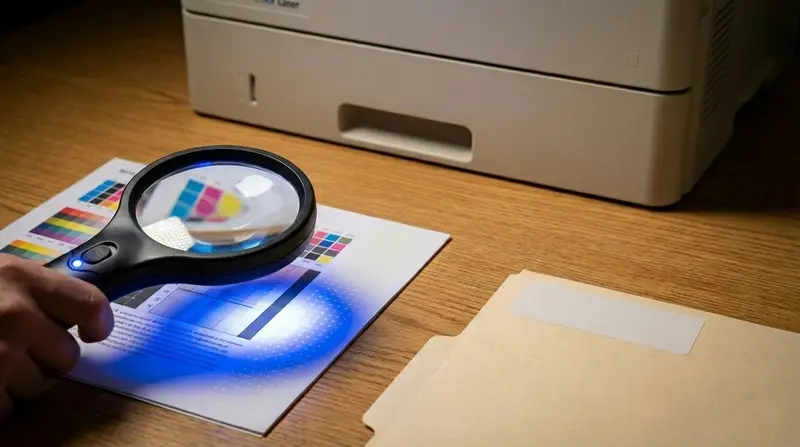

Machine Identification Codes (MIC), commonly known as tracking dots or yellow dots, are microscopic patterns embedded in nearly every page produced by many color laser printers and copiers. These patterns consist of tiny yellow dots—typically less than 0.1 mm in diameter and spaced in a repeating grid—that are nearly invisible to the naked eye under normal lighting. They are designed to blend into white paper, appearing only under magnification, blue LED light, or enhanced scanning.
The dots function as a form of steganography, encoding data in a grid (often 8×15 or similar configurations, repeated across the page). Technical analyses, including those by the Electronic Frontier Foundation (EFF) and researchers at TU Dresden, confirm that the patterns reliably encode the printer’s serial number and the date and time of printing. For example, in Xerox DocuColor models, the grid uses binary representation (dot present = 1, absent = 0) with parity bits for error correction, yielding up to 14 bytes of data, of which about 10 are typically used for the serial number (in binary-coded decimal) and timestamp.
What is confirmed across manufacturers like Xerox, Canon, HP, Brother, Epson, Ricoh, and others: the serial number uniquely identifies the device, and the timestamp reflects the printer’s internal clock. Variations exist—some models include model-specific configuration data or operating mode (print vs. copy)—but public decoding is limited to older patterns, such as the Xerox DocuColor scheme fully reverse-engineered by the EFF in 2005. Newer printers may use evolved or alternative encodings (e.g., modulated laser intensity or non-yellow marks), which remain opaque to independent researchers. The EFF’s 2015 assessment, based on Freedom of Information Act documents, indicates that major manufacturers likely incorporate some forensic tracing mechanism, though not always visible yellow dots.
Origins: Counterfeiting Prevention Through Informal Government Encouragement
The technology traces its roots to the mid-1980s, when high-quality color laser printers raised concerns about currency counterfeiting. Xerox pioneered the yellow-dot system in its DocuColor line, patenting a method (U.S. Patent 5,515,451, granted in 1996 but describing earlier implementations) to embed identifying marks. Fuji-Xerox, a joint venture, first deployed it in response to Japanese government requirements for traceable printouts.
No public evidence shows a legal mandate in the United States or most countries; instead, adoption stemmed from informal agreements. Governments, including the U.S. Secret Service, persuaded manufacturers to implement tracing to deter counterfeiting. The Central Bank Counterfeit Deterrence Group (a consortium of central banks) has denied developing the feature, but FOIA-released documents reviewed by the EFF suggest coordinated arrangements ensuring forensic traceability. Manufacturers describe it as a voluntary anti-counterfeiting measure, with some (like Xerox) later acknowledging it publicly as a security enhancement.
The first documented law-enforcement use occurred in 2004, when Dutch authorities traced counterfeiters via dots on a Canon printer. Similar applications have focused on forgery investigations, though the technology’s scope extends beyond currency.
Disclosure and Consumer Awareness
Printer manufacturers rarely inform consumers about MIC. User manuals, product specifications, and sales materials from major brands (e.g., HP, Canon, Xerox) typically omit any mention, as confirmed by EFF reviews and independent analyses. Some Xerox models include brief notes about “anti-counterfeit systems,” but these are vague and not prominent. Public statements from companies emphasize counterfeiting prevention without detailing the mechanism or its presence on every page.
This lack of disclosure contrasts with principles of transparency and informed consent. Consumers purchase devices assuming privacy in personal printing, yet the firmware-level embedding occurs automatically and without opt-out. Digital rights organizations like the EFF argue this undermines user autonomy, as individuals cannot knowingly consent to or avoid a feature not advertised.
Who Is Affected: Documented Risks for Sensitive Printing
The technology primarily aids law-enforcement tracing in counterfeiting cases, but documented instances highlight risks for others. In 2017, U.S. authorities arrested NSA contractor Reality Winner after she printed and leaked classified documents; experts identified yellow dots in the published scans matching a Xerox printer’s pattern, corroborating the timestamp and aiding identification (though internal logs also played a role).
Expert assessments from the EFF and TU Dresden note plausible risks for journalists sourcing anonymous prints, whistleblowers distributing physical documents, and activists in repressive regimes printing dissenting materials. No widespread abuse is documented, but the opacity and traceability raise concerns acknowledged in European Parliament queries (2007) about potential privacy violations under human-rights frameworks.
Mitigation Strategies and Their Limitations
Not all printers embed visible yellow dots. The EFF’s list (last updated 2017) identifies older models without them, such as certain HP Color LaserJet 4500/8500 series and some Oki printers. Monochrome (black-and-white) laser printers and inkjet printers show no evidence of yellow-dot tracking, though subtle alternatives cannot be ruled out.
Practical mitigations include:
Printing in grayscale or pure black (100% K), which avoids yellow toner entirely.
Post-print processing, such as photocopying, which may obscure dots.
Advanced tools like TU Dresden’s DEDA software (2018), which extracts patterns and anonymizes by overprinting additional yellow dots.
Trade-offs are significant: grayscale limits color output; overprinting requires compatible printers and may not defeat evolved encodings; older “dot-free” models are outdated and harder to source. Assuming universal tracing in modern color lasers remains the safest expert recommendation.
Broader Implications
Machine Identification Codes illustrate a tension between legitimate security objectives—preventing counterfeiting—and consumer rights to transparency in everyday devices. While no evidence supports claims of routine mass surveillance via printers, the undocumented embedding of identifiable information on personal documents raises ethical questions about consent and accountability.
In an era of ubiquitous technology, this practice underscores the need for clearer disclosure standards. Manufacturers could offer opt-outs or prominent warnings; regulators could require them. Balancing law-enforcement tools with individual privacy demands ongoing scrutiny, ensuring innovations serve public interest without eroding trust in common household devices.
Primary sources anchoring this analysis include EFF investigations (2005–2017), TU Dresden research (2018), U.S. Patent 5,515,451, and corroborated reports from technical outlets. Unresolved aspects—exact encodings in current models and full government-manufacturer agreements—highlight areas warranting further independent inquiry.