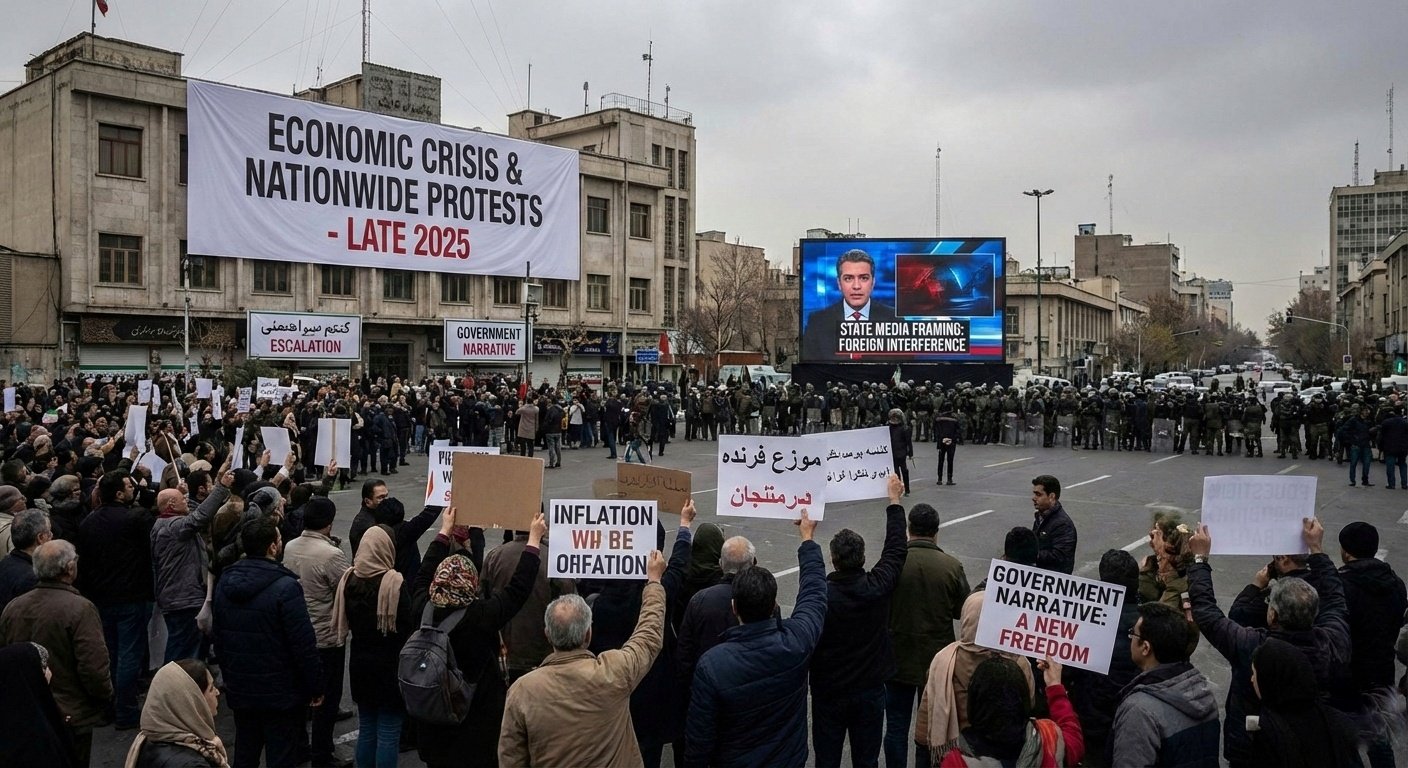

Mass demonstrations that began over acute economic distress in late December 2025 have spread to all provinces and evolved into broad anti-government expressions; Iranian authorities frame the unrest as externally instigated violence aimed at destabilizing the Islamic Republic, while independent rights groups document heavy security-force lethality and a communications blackout.
Beginning 28 December 2025, protests erupted in Tehran — initially among bazaar merchants responding to a sharp currency depreciation and runaway inflation — and rapidly expanded across all 31 provinces, drawing diverse participants and slogans challenging the Islamic Republic’s political system. President Masoud Pezeshkian initially acknowledged economic grievances and the right to peaceful protest, but senior officials, including Supreme Leader Ali Khamenei and Foreign Minister Abbas Araghchi, have consistently attributed the escalation and bloodshed to foreign orchestration — principally by the United States and Israel — rather than domestic failures. Independent reporting and rights organizations have recorded hundreds of protester deaths and mass arrests amid a nationwide internet and telecommunications shutdown imposed around 8 January 2026.
References Used
Primary Sources:
- Statements by Supreme Leader Ali Khamenei (e.g., describing protesters as “vandals” and “saboteurs” acting to please foreign powers, January 2026 speeches and remarks reported via state media and international wires).
- Public remarks by President Masoud Pezeshkian (acknowledging economic hardship, promising dialogue on grievances, and warning against destabilization, via state television interviews and announcements).
- Foreign Minister Abbas Araghchi (alleging protests were made “violent and bloody” to provide pretext for U.S. military intervention, remarks to diplomats in Tehran, 12 January 2026).
- Iranian state media (IRIB, Tasnim, IRNA) reporting on security-force casualties, “riots,” and alleged foreign-backed terrorism.
Secondary Reporting & Analysis:
- Al Jazeera, The Guardian, CNN, Reuters, The New York Times, Amnesty International, Human Rights Watch, HRANA (Human Rights Activists News Agency), Iran International (coverage of protest triggers, casualty estimates, internet blackout, and official statements, December 2025–January 2026).
- Wikipedia summary entry on “2025–2026 Iranian protests” (compiling timelines and cited reports as of mid-January 2026).
Method Notes:
Casualty figures vary widely and remain difficult to verify independently due to the communications blackout (connectivity reportedly at ~1% of normal levels since 8 January 2026). Rights groups rely on networks of activists, hospital sources, and smuggled footage (often via satellite links such as Starlink); state media emphasizes deaths among security personnel and denies or reframes protester fatalities. No party has released comprehensive, audited lists.
Context and Factual Grounding
Iran’s economy has faced structural strain for years, intensified by layered international sanctions, domestic mismanagement, declining oil revenues, and — in 2025 — the effects of military conflict with Israel and the United States that targeted nuclear and missile infrastructure. By late 2025 inflation approached or exceeded 50–60% (World Bank projections), the rial depreciated sharply, subsidized fuel and food prices rose, and chronic electricity/gas shortages persisted despite public apologies from President Pezeshkian.
The immediate trigger on 28 December 2025 was bazaar merchants in Tehran closing shops in protest against currency collapse and price surges on basic goods. Bazaar traders historically played a pivotal role in the 1979 revolution; their participation carried symbolic weight. Demonstrations spread quickly to other cities, initially focused on livelihoods but soon incorporating broader political demands.
By early January 2026 protests had occurred in hundreds of locations across every province. Verified videos and eyewitness accounts documented large nighttime marches in Tehran, Mashhad, Tabriz, and elsewhere, with participants waving the pre-1979 Lion and Sun flag and chanting slogans such as “Death to the Dictator” (referring to Supreme Leader Khamenei) and calls associated with the Pahlavi monarchy.
Security forces — including police, Basij paramilitaries, and in some areas IRGC units — deployed tear gas, shotguns with pellets, live ammunition, and mass arrests. A nationwide internet and mobile-data blackout began around 8 January 2026, severely restricting information flow in and out of the country. Rights organizations documented dozens to hundreds of protester deaths in the first weeks (early estimates 28–62, later rising significantly in some reports), alongside injuries and detentions numbering in the thousands.
President Pezeshkian publicly recognized economic causes and offered dialogue, but control over repressive apparatus lies primarily with the Supreme Leader and IRGC-linked structures, limiting the executive’s ability to de-escalate.
Claims, Signals, and Interpretations
The Iranian government’s core narrative, repeated across state media, Supreme Leader speeches, Foreign Ministry statements, and judiciary pronouncements, is that the protests are not organic expressions of domestic discontent but engineered violence by external enemies — chiefly the United States and Israel — seeking regime change.
Foreign Minister Araghchi asserted (12 January 2026) that demonstrations were deliberately made “violent and bloody” to create a pretext for U.S. military intervention, linking escalation directly to President Trump’s public warnings that the U.S. would act if Iran killed peaceful protesters. Supreme Leader Khamenei labeled demonstrators “vandals” and “saboteurs” acting to please foreign powers, accusing them of attacking public property and serving as “mercenaries for foreigners.”
State media and officials have highlighted casualties among security personnel (dozens to over 100 reported killed) to portray protesters as aggressors employing tactics resembling “ISIS.” The narrative frames legitimate economic complaints as hijacked by “terrorist agents” and “rioters,” distinguishing a small core of “legitimate” complainers from a violent, foreign-directed majority.
Timing of the framing aligns with U.S. President Trump’s repeated threats of intervention and offers to restore internet access via Starlink. Israeli officials’ public support for protesters further fuels the external-enemy line. The internet blackout is officially unexplained or downplayed but widely understood by rights groups as a measure to obscure the scale of repression and hinder protest coordination — a pattern seen in prior unrest (2009, 2019, 2022).
Power Structures and Constraints
The Islamic Republic’s security architecture is layered and decentralized in appearance but centralized under the Supreme Leader. Day-to-day crowd control falls to the Law Enforcement Command (FARAJA/police) and Basij; escalation brings in IRGC Ground Forces, which treat certain protest zones as near-insurgency environments.
The president’s reformist platform and promises of dialogue have limited reach over coercive institutions, creating visible tension between executive rhetoric and security-practice reality.
The communications blackout reflects regime concern about protest momentum and international scrutiny; it also limits domestic coordination but has — in some accounts — increased street turnout by removing distractions.
Publics are not monolithic: economic distress affects bazaar merchants, workers, students, pensioners, and youth, yet state-aligned constituencies (including some religious and military networks) have held counter-demonstrations. Ethnic and regional minorities (Kurdish, Baloch, etc.) have joined but face additional repression.
Material constraints include an economy already strained by sanctions, war damage, and energy deficits; prolonged unrest risks further capital flight and service collapse.
Consequences and Secondary Effects
Short-term effects include hundreds to thousands of injuries and arrests, overwhelmed hospitals (especially in Tehran and Shiraz), and disrupted commerce in protest cities. The blackout has isolated Iran informationally, hampering external verification and domestic organizing while allowing state media to project calm.
Longer-term risks involve deeper erosion of legitimacy if economic grievances remain unaddressed and repression continues. Failure to contain unrest could embolden further mobilization or fracture security cohesion.
If the government’s foreign-conspiracy framing fails to resonate domestically or internationally, it may accelerate isolation and sanctions pressure. External intervention threats carry escalation dangers, including retaliatory strikes on U.S./Israeli assets, though actual military action remains speculative.
Communities bearing greatest risk include protesters and bystanders in flashpoint cities, ethnic minorities in border regions, and families of detainees facing potential harsh sentencing.
What Is Known, What Is Uncertain
Confirmed Facts:
- Protests began 28 December 2025 in Tehran over currency collapse and inflation, spreading to all 31 provinces within days.
- A nationwide internet and telecommunications blackout was imposed around 8 January 2026 and remained in effect into mid-January.
- Security forces have used live ammunition, pellets, and mass arrests; state media has reported dozens of security-personnel deaths.
- President Pezeshkian publicly acknowledged economic hardship and the right to peaceful protest; Supreme Leader Khamenei and Foreign Minister Araghchi have explicitly blamed the U.S. and Israel for instigating violence.
Contested Claims:
- Death tolls: Rights groups (HRANA, Amnesty, etc.) report dozens to hundreds of protester fatalities (some estimates far higher during blackout periods); Iranian authorities emphasize security-force losses and deny or reframe protester deaths as resulting from “riots.”
- Foreign orchestration: Iranian officials assert U.S./Israeli direction of violence; no independently verified evidence substantiates direct external operational control of the protests.
Unknowns or Missing Data:
- Precise nationwide casualty figures, especially post-blackout.
- Exact scale and coordination of protests in real time (blackout severely limits documentation).
- Whether economic concessions or dialogue will materialize versus further repression.
Continued independent scrutiny of casualty claims, communications access, and economic policy responses remains essential to separate verified events from competing narratives.